the Wakefield Doctrine | the Wakefield Doctrine - Part 2 the Wakefield Doctrine | the Wakefield Doctrine - Part 2

Monday -the Wakefield Doctrine-

Welcome to the Wakefield Doctrine (the theory of clarks, scotts and rogers)
We’re gonna start the week’s Doctrine post series with some AP Wakefield Doctrine insights, courtesy of our diligent correspondent, Misky. In a comment at last Tuesday’s post, she say,

…which leads me to a person that explains a problem to the electrician in 200 words when 12 would do the same.

New Readers! the question our friend raises goes to the heart of the Wakefield Doctrine. It’s primary conceit, (in the good sense of the word), is to afford all those with the intellect, curiosity and desire to add to their respective realities an additional insight into the acts and behavior of the people around us (and the world that makes them up*). The Wakefield Doctrine offers and insight into three distinct ways to experience reality, as a:

  • clark (the Outsider)
  • scott (the Predator)
  • roger (the Herd Member)

Through the pages of this blog are a buncha descriptions of the characteristics of the above three predominant worldviews (aka personality types). Spend the time learning. Today’s post is designated as AP level as we are considering the Everything Rule.

ok! back to Misky’s Conjecture as to how verbosity relates to personal reality. Our invocation of the Everything Rule brings into play a key concept: manifestation. Specifically, how does giving instruction (to a trade or other non-related individual.**), manifest in the personal realities of clarks, scotts and rogers? As with the standard process of determining predominant worldviews, Misky has, in effect, thrown out one, (of the three), leaving us with a comparison to two seemingly identical actors.

btw: a scott tends to be less …loquacious than ‘the other two’ if for no other reason than in the world of the Predator, ya don’t need too much filigree on: Run! Run Away! Eat! Reproduce! Sleeeep! lol

As to verbosity in clarks and rogers:

  1. the Outsider (clarks) are eternally curious. their lives being a search for the information that might enable them to become ‘a part of’. As such, all information has value. Combine this view with their tendency to want to share with others (yeah, half-thought-through protective coloration lol) and so will in our scenario provide more (information) rather than less. just ’cause
  2. the Herd Member (rogers) are concerned, first and foremost, with the Herd. Everything in their world is connected (to the people and elements of this) and so, in the process of giving direction to an electrician, see no reason to leave out: the electricians that they have known, the people who have had bad experiences with the work under consideration and the fact, that as a person, all of this puts them in a position of being… well, a peer, to the expert they are now directing.

ain’t this Doctrine fun?


*lol a little reversal of our standard, ‘…the world around us and the people who make it up.’

** yeah, if related? way different conversation lol

 

Share

TToT -the Wakefield Doctrine-

Welcome to the Wakefield Doctrine (the theory of clarks, scotts and rogers)

This is the Wakefield Doctrine’s weekly contribution/participation-in/’whew!-made-it-another-week!’ as your host of the Ten Things of Thankful (TToT) bloghop. We’re glad you made it. While you’re here, if you’re a Reader, please consider dashing off a list of the ten things that come to mind (recently and/or really?!!? you still remember that? jeez the things the subconscious sticks in the ‘don’t leave this plane-of-existence without it), of people, places, things and events that elicit and otherwie jumpstart a sense of gratitude.

…for the Doctrine we submit:

1) Phyllis

2) Ola

3) the Wakefield Doctrine

4) from one of our favorite utube channels (chill dude explains) an episode on smells. two things he left out: mimeograph ink and newsprint though, to his credit he did have as number 2 (the smell of)  bowling alleys.

5) the Six Sentence Story bloghop

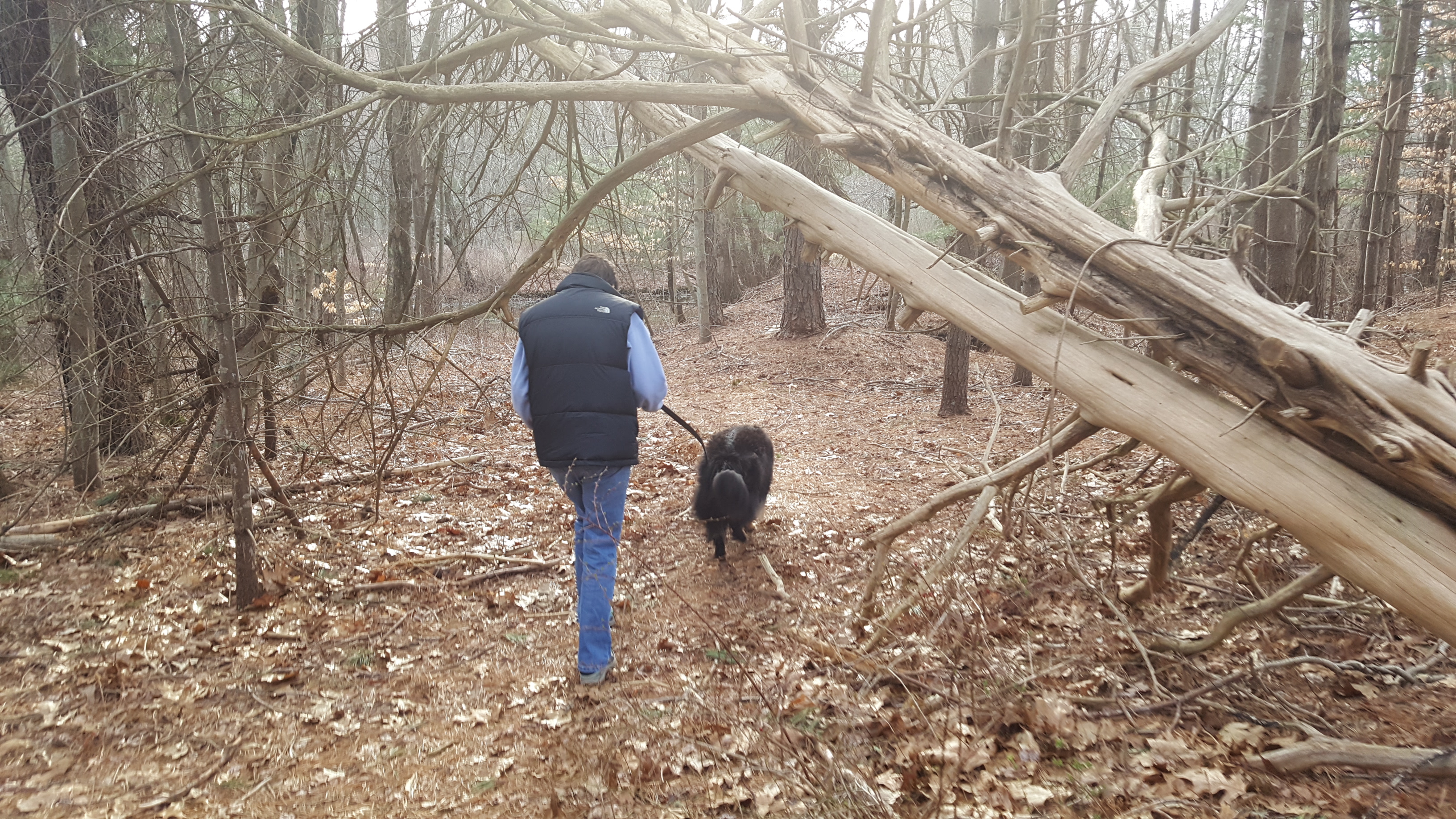
6) video of walking through the woods on a raw, rainy Saturday morning (so you don’t have to)

7) photo at the top of the post? Our first German Shepherd, Ola. One of our favorite Ola stories: when still a young dog we tried to give her a bath. Didn’t enjoy it. Fine, we tried. Another fact of life Ola did not find agreeable was that we both had to go to work, (in those days, remote offices). One morning we were all finishing our daily get-ready to leave for work routines and noticed our dog was nowhere to be found. Looked in almost every room. Finally, Phyllis opened the bathroom door and there was Ola, sitting in the bathtub. There was zero doubt in our minds that our dog was trying to open negotiations on our staying home. We stay, she’d submit to bath.  Ola was that kind of dog.

8) something, something

9) as if the live-action video walk wasn’t convincing enough  below is a still photo (with bonus feature of the progress Phyllis has made in her stacking of firewood0 of dead leaves on trees.

10) Secret Rule 1.3

music vids

*

*

*

You are invited to the Inlinkz link party!

Click here to enter

Share

Wait, what?! -the Wakefield Doctrine- …somehow, it’s half-past Friday and we haven’t written our Doctrine post

Welcome to the Wakefield Doctrine (the theory of clarks, scotts and rogers)

New Readers; the content in this blog consists of three categories: 1) Wakefield Doctrine posts Monday, Tuesday, Wednesday and Fridays (being all things Doctrine), b) Six Sentence Stories (fiction for a bloghop run by Denise) posted on Thursdays and  tres) the Ten Things of Thankful (TToT) gratitude bloghop (with a difference) on Saturday hosted (currently) by yours truly, (link to last week’s TToT why not join us this weekend?)

So if you’re curious about this little personality theory thing of ours, those are the days to get the skinny* on the hows and whats of one of the most fun alternative perspectives on the world around us and the people who make it up.

In any event, we are fortunate in having Readers who write comments that more often than not suggest themes and topics for posts (and in recent weeks) series of posts devoted to the question.

Among them are Mimi, Frank, Misky and Denise (with occasional fly-bys by Friend-of-the-Doctrine Cynthia).

So don’t be shy with your Comments or Questions.

Closing out this week: we started with the topic of the reality of personal realities. Central to the Doctrine and fun to consider how each of the three predominant worldviews (aka personality types) grow up developing the perfect personality type…given the reality they experience. Then we went with a RePrint of the Doctrine’s origin story (the Eureka Moment)

As should be abundantly evident, we all have fun learning how to see the world from a peculiar angle. (You into people watching? You will love the Doctrine)

lets close this short post with the essential: clarks think, scotts act and rogers feel.


Share

Wedezdae -the Wakefield Doctrine-

Welcome to the Wakefield Doctrine (the theory of clarks, scotts and rogers)

from a Comment from Frank on yesterday’s post.

Since I wouldn’t want to mar the new equipment with a piece of tape, I would have shown the customer how to turn the dial. So, I’m not a scott. A roger might go into greater detail about how dials work than I would. I guess I’m a clark.

ok!.. your Comment provides our New Reader with a good set-up to illustrate how to determine a person’s (or your own) predominant worldview:

a) throw out the ‘no fricken way!’ personality type  2) now compare the remaining two worldviews, ‘side-by-each’ and decide which one provides the clearest/in-focused view of the world.

ProTip: here is where your reading pays off, i.e. sure, you know that ‘clarks abhor being in the spotlight but will not tolerate being ignored, but how does being in the spotlight manifest* for a roger?’ or ‘the Herd Member knows there is a correct way and a lot of other ways that are worse than being merely incorrect, but what does the Outsider think of their responsibility for a mistake on the part of another person?’ You do see where we’re going with this, don’t you?

Who said ‘It’s about how a person relates themselfs to the world around them, (and the people who make it up)?’ very good… but isn’t there something about this statement that really matters?

Yep! The ”…a person relates themselves…’ part. The Wakefield Doctrine isn’t all ‘7os pop psych, ‘oh wow, I can relate to that. …err man!’

The Wakefield Doctrine demands more from those who would advantage theyselfs of the insights it offers. To do this right, one perforce needs to understand, (as much as possible in the current moment), accept (as a working description of the world) and let this self-knowledge afford them the perspective on the other person.

So, our valued correspondent, Frank is (or should be asking himself): ‘What do I think about the solution to the problem of the ‘Misunderstanding Customer’ and immediately afterwards, ‘How do I feel about the lack of understanding of this equipment that this total stranger rudely demands an answer to the question, “Why doesn’t this thing work?”

lol

* reminder: ‘the Everything Rule’ states: ‘everyone does everything at one time or another‘ which simply means there is no exclusivity of actions, interests, sins, ideals and/or expertise among clarks, scotts and rogers… a thing may, however, manifest differently for each

Share

2sdae -the Wakefield Doctrine-

Welcome to the Wakefield Doctrine (the theory of clarks, scotts and rogers)

Now that we’re all safely in Tuesday (the mildest day of the workweek) what say we check in our friends/Commentationers/-ettes

from Mimi:

In my reality, it’s good to be an outsider, but to see things through the lens of a predator or a herd member when needed.

then Misky:

I will say this: The Doctrine has given me a wee bit more patience for other perceptions that might’ve (well, actually, that really thoroughly) bugged the heck out me previously.

finally (the later episodes opening song lyrics ‘the Professor and Maryanne are here on….) Frank:

It sounds like we have better (I mean, worse) things to repent of than being either a clark, a scott or a roger.

How true (and perceptive)!

(In reverse order)

  • the three ‘personality types’ of the Wakefield Doctrine, more properly referred to as one’s predominant worldview, is both label and description of the first/primary relationship we, all of us, establish with the world. It is this context that we maintain and build a set of coping (and thriving) mechanisms/social strategies that persist throughout our lifes.
  • as an alternate perspective on the world around us, (and the people who make it up), the Doctrine offers a view from aside
  • to see the world not only as it exists for us, but to understand (or, at very least, gain an appreciation of) the world and everyday life as those around us are experiencing it is the most worthy of ambitions

cool

hows about we close with a RePrint/ReMinder of the ‘Eureka Moment’ of this here personality ‘theory’ here?

In the early 1980’s, Scott (the progenitor scott) worked at a music store in Pawtucket, Rhode Island. He was the only full-time salesman and (also) ran the store’s repair department. In addition to musical instruments, the store provided repair services for a wide range of electronic equipment, including  tape recorders and other audio equipment.

One day I happened to stop by the store to visit. While there, a young man walked into the store, went directly to the ‘repair department’ where Scott and I were talking and without preamble placed a ‘dual cassette recorder’ on the counter. A dual cassette recorder was designed to allow one cassette to be copied directly to another, what today we would call, making a back up. The controls on this ‘dubbing recorder’ consisted of two sets of tape recorder controls: Volume, Treble and Bass. Where it differed from a single recorder was that it also had a Master Volume control. As the name implies it controlled the volume level, for both recording and playback. The tape recorder the customer placed on the counter appeared to be new and showed no signs of damage or abuse. I stepped back, Scott looked up and said, ‘What can we do for you’?  The customer said, “This thing is brand new, it worked for a couple of days, then it stopped working entirely. I can’t figure out what’s wrong”.

Scott looked at the device for a second, then, without a word, reached under the counter, brought out a roll of black electrical tape, and, tearing off a 2 inch piece, taped over the Master Volume control (after returning the dial to it’s highest setting). He then slid the device back over the counter and said, “There, it’s all right now.”

The customer asked to plug in the recorder. Taking a cassette from his pocket he put in the machine and ran it through it’s paces. Satisfied that  his ‘broken tape recorder’ now worked like new, he thanked Scott and walked out of the store, a totally satisfied customer.

My reality shifted. For reasons unclear to this day, although I observed what scott saw as to the nature of the problem with the dual cassette recorder, I realized that the character of his solution implied a reality, a ‘context’ that was clearly different from mine. At that moment I came to believe the personal reality that I experience as I went about my life was not necessarily the exact reality of anyone else. That the manner in which Scott perceived the ‘problem’ was fundamentally different from the way I witnessed it.

From that moment, standing in a small music store in Pawtucket, I’ve been observing the behavior of others knowing with the conviction that what I could see was not necessarily what they are experiencing. That, in fact, all reality is personal to a small, but significant degree, personal.

This blog is all about: ‘Can I find a way to better see the world as the other person is experiencing it?. And, (through this effort), ‘Can I improve and enhance how I relate myself to the world around me and the people who make it up?‘

Welcome to the Wakefield Doctrine (already in progress…feel free to wander around)

(above excerpt from 2009)


Share