relationships | the Wakefield Doctrine - Part 2 relationships | the Wakefield Doctrine - Part 2

Monday -the Wakefield Doctrine-

Welcome to the Wakefield Doctrine (the theory of clarks, scotts and rogers)

While we try to remember the (suggested) topic for the week’s first post, lets rummage through the Box ‘o RePrints, shall we?

…wait! stop the keyboard! we have a little video from our own Golden Years of video/audio Doctrine/Curator!

the heck with adieus

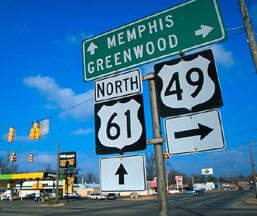
ok, a little backstory: for a few years, at the end of the First Decade of the Second Millennium, we had cause to travel on business, once (or twice) a year. For reasons, lost in the Fog of Bore, we decided that, on each trip, rather than fly directly home, we would do some clarklike* tourism at places that held an attraction (for us). One such trip included a drive through Mississippi to see the Crossroads of Robert Johnson fame.

here:

* so, for a clark, tourism is about what, as kids, we used to call ‘touching hands’** Point of Interest, drive there, get out of car, take photos or videos, get back in car and leave.

** i.e. scary old house, ideally with keep out signs all over the place, the dare was ‘touch hands’ which was not ‘go on the property or get there it’ rather it involved touching it (running away was permitted and encouraged afterwards)


Share

Tuesday -the Wakefield Doctrine-

Welcome to the Wakefield Doctrine (the theory of clarks, scotts and rogers)

Very enjoyable (and insightful) Comment/Reply from our regular Readers this week:

Mimi:

The “nice and friendly” is my rogerian secondary showing off so as a Clark-like female I don’t make enemies

This in response to our assertion that several of the clarklike Readers of this blog “there are clarks i.e. Mimi and our T-shirt model above (Cynthia) who are genuinely nice, friendly and not (necessarily) kinda intimidating.” (From Monday’s post)

Misky:

Nice analogy — that optometrist thing.

A totally appreciated compliment for part of our Reply to Frank’s Comment, i.e. learn the characteristic views of each of the three to the extent that one can see through their eyes, or, to be more realistic, to respond to aspects of the world sympathetic to Outsiders (clarks), Predators (scotts) or Herd Members (rogers). compare and contrast, yo.

Frank:

After reading the page of rogers, I’m beginning to think I might be a roger.

To which we replied:

ok… the beauty part of the Wakefield Doctrine is how it’s value lies in the individual identifying with their predominant worldview*. So cool. Dive into it. Remember: You can’t get it wrong. Will do tomorrow’s post on rogers…see how you feel about that

* reminder: optometrist ‘Look at Line 6 it is clear? Now (click of switching lens) How about now? And Is this clearer? Except the lenses are the world as seen by the three characteristic relationships (Outsider, Predator, Herd Member) and the letter chart is the world around you

And the thing of it is, the kind of people who ‘get’ the Wakefield Doctrine, are, by definition, those who embrace their curious side and have the (intellectual) self-confidence to play with ideas and perspectives and such. You know, them what have secondary clarklike aspects. lol


*

Share

Friday -the Wakefield Doctrine-

Welcome to the Wakefield Doctrine (the theory of clarks, scotts and rogers)

Damn! Readers they gettin’ this here Doctrine here, big-time. Fluent in the Doctrine much, M?*

From Mimi

As a janitor clark-like person, i deal with messes scotts and rogers make all the time. The scotts’ messes are from simply being who they are, the rogers, it’s from not thinking because of not having a clark-like secondary.

And, really, while it surely does not rise to the level of: (hands clapping a person’s shoulders in a summer tent in a rural field) “Get up (-uh). You can walk(uh). Can I get an Amen!”1 Readers at a certain level will sense the implication in M’s little quote. The mind behind the mess is discernible in the character of the mess.

In the world of a Predator, it’s not “Hey, slow down, I need to find a trash receptacle for my Big Mac box and Coke… ok ok I’ll come back after I catch you.” (throws the litter over her/his shoulder) and continues the chase.

In the land of the Herd Member, “Excellent burger and coke. What’s next on today’s agenda. No time, no time! We’ll just store the empty box somewhere for safe keeping… there’s room on the floor on the passenger’s side for just one more! Look at the abundance of our Life!!” at some point in time there will be something of a ceremonial ‘cleaning up’ which is as much assertion of status in the world (of lunches on the go or discarded packaging in the workshop).

Ear Worm Warning!! That last line triggered the perennial affection of the song ‘Kid Charlemagne’ (one of the finest guitar soloes ever)

1) one of our guilty pleasures when in the car is to listen to a local gospel station. Not everyone on it, but there are a few that, in oratory style, have it. Can’t describe it… very much a case of ‘the medium more than the message’.

In any event, on Saturday night there is one very old-school guy. Sounds older that the usual line up, his sermons are also of a time gone by, but his speaking style! There is the accent on the ends of certain sentences (not every one, just enough to know that it’s deliberate and for emphasis) where he adds an ‘-uh‘ to the last word of a sentence – uh. You can see the prairie and the hear the canvas flapping in the wind, don’cha know,

*in the spirit of loosening up our-owneself: no! not to worry, I am totally including Frank in this compliment, M. (lol)


Share

Wednesday -the Wakefield Doctrine-

Welcome to the Wakefield Doctrine (the theory of clarks, scotts and rogers)

From Reader Frank, the following:

Here is a question that has been bothering me. Suppose we have the typical situation of knight, damsel and dragon. Which one of these is the clark, scott or roger? I kind of think the knight would have to be a scott, but I don’t know about the other two. Of course, the dragon could also be a scott. Even the damsel.


even the damsel

we know you’ve been trying to find a way to sneak up on that angle! lol

damn! lost our train of thought… and the ticket and a cab-ride home.

Let’s try a quick SOC(ish) approach.

Now, if our faithful correspondent is, in his Comment, thinking fairy tales and such, the ground is quite simple.

Pied Piper of Hamlin:

  • (the) Piper: scott
  • (the) Children: clarks
  • (the) Townspeople: rogers

Little Red Riding Hood:

  • (the) Wolf: scott
  • (the) Grandma: clark
  • Little Red Riding Hood: roger

The Garden of Eden:

  • (the) Serpent: scott
  • Eve: clark
  • Adam: roger

Does it stop with these, above deconstructions?  “mais non bien sûr que non!”

What the question (from our Reader) asks is: in the context of there being a knight, a damsel and a dragon are each of these always going to be a scott, a clark and a roger, or what?

The Answer: depends on one’s definition of: a knight, a distressed damsel and a fire-breathing dragon. Clearly (from this ‘Answer’) we differ with our Interlocutor.

We, on first blush, think of:

  • a knight (roger) as a part of a medieval culture who is in the minority/exceptional, owes his (take note of gender) rank and privilege to a powerful figure (remember ‘referential authority’ a hallmark of the rogerian worldview) and acts on behalf of the establishment.
  • a damsel (clark) while of a lesser status than everyone else in the context, is exceptional in that she perseveres and, in fact, commands attention of both the dragon (who doesn’t simply eat her and move on to the next meal) and the knight (by proxy the authority figure, which in this cultural meme is a king or some other exceptionally powerful male), she is, in the context of this story, commanding the attention of all while apparently powerless and passive
  • the dragon (scott)  just trying to live, gotta eat…usually predates the kingdom and power structure of the interloping culture


questions?

the value of such exercises? to learn the characteristic relationships (with the world) that are referred to as Outsider (clark), Predator (scott) and Herd Member (roger) and in the process better understanding (at least from a different perspective) of ourselfs.

thanks, Frank!

*

Share

Tesudae -the Wakefield Doctrine-

Welcome to the Wakefield Doctrine (the theory of clarks, scotts and rogers)

Say you’re out and about today.

It’s summer, (here in Oceania), despite the store displays being torn down and replaced by Pumpkin-infused Halloween merchandise.

You’re out on errands or whatever GenMe calls: getting gas at the Seven-Eleven, stopping at work to pick up your check or driving by the beach to see if your ennui can be banished by the sight of non-old bodies in minimal clothing exhibiting hypo-organized behavior.

You’ve studied your Wakefield Doctrine.

You have a solid grasp of the characteristics of the three predominant worldviews*, at least on the level comparable to going on a trip to Spain during your last year in Spanish Club.

What is the purpose of the Wakefield Doctrine?

It is not:

  • finding something to do that on your trip that will, somehow, make it special… wait, it is kinda that
  • discovering a part of your life, (promise not to stop reading? … gain a new appreciation to a part of your life) damn! busted
  • laugh at the foibles of your fellow lifeforms and, at the peak ha-ha-moment, realize many of things you dislike about yourself aren’t so awful…shit! (maybe we shouldn’t’ve committed to this bullet point thing so hard**)
  • allowing the weight of ‘doing things correctly’ to lighten to a few-ounces-less-than-glum.  boy-oh-boy better hope the word count is enough to quit this ‘What the Wakefield Doctrine is not’ schtick
  • the Answer…. finally!!  a valid point. the study, use and embrace of the perspective afforded by the Wakefield Doctrine is not ‘the Answer’
  • the way to change the things in others close to you… shit, near the end and now we’re on a roll!! The famous saying/advisory to New Readers is: ‘the Wakefield Doctrine is for you, not them. (figure it out). It does, however, offer a chance to avoid one’s own triggers when interacting with others… these triggers being very much a part of maintaining the “I really like them except for when they…”

out

*aka personality types:

  • clarks (Outsiders)
  • scotts (Predators)
  • rogers (Herd Members)

** thanks to the writers of ‘The Good Place’ for the rhetorical device, you need to watch to the very end, though


Share